


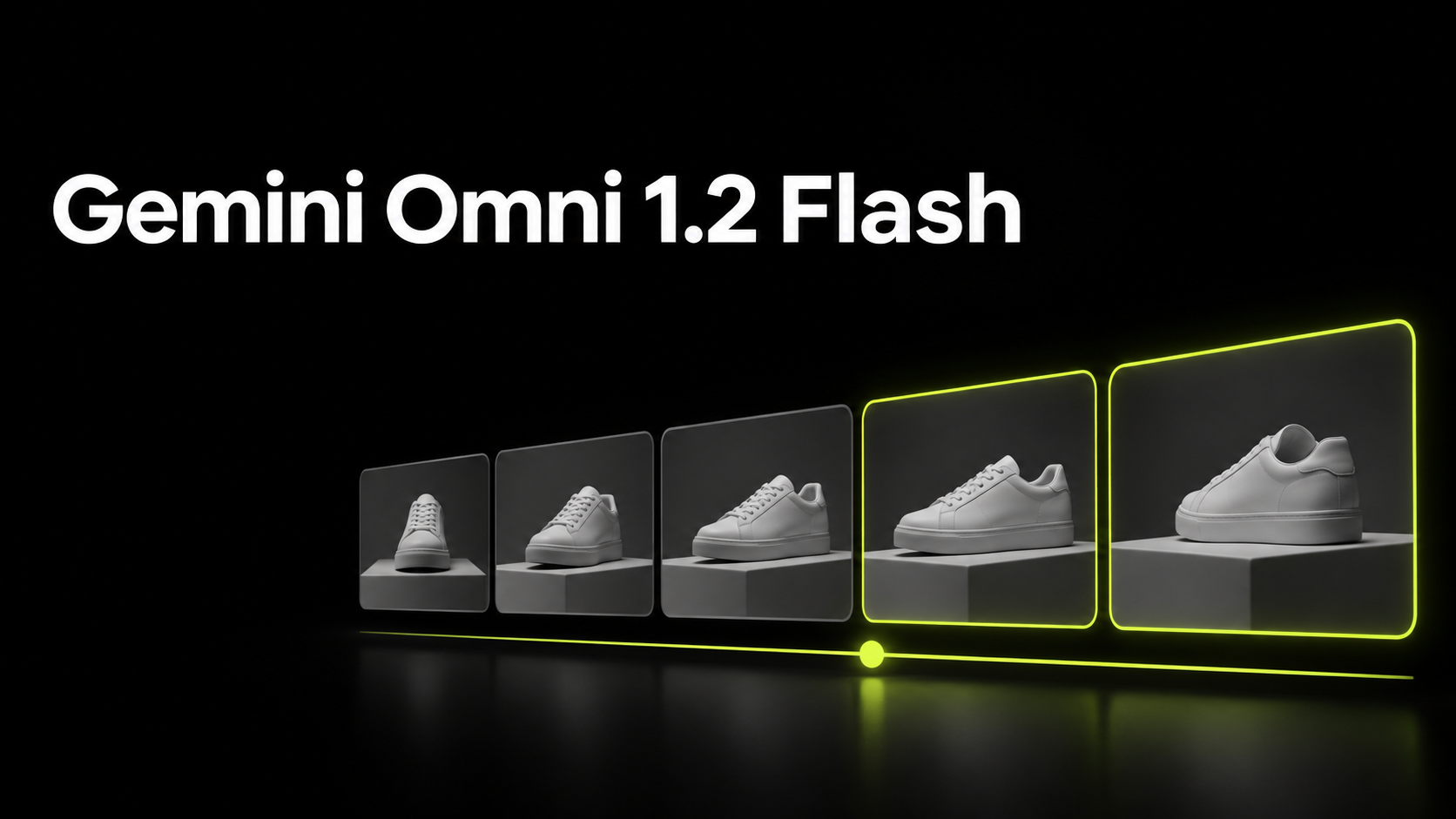
Anyone building short video ads on Gemini Omni 1.1 Flash hit the same wall: 10 seconds per generation. A 15-second social spot meant stitching two clips together or extending one, then hoping the characters and products survived the seam. Gemini Omni 1.2 Flash, which Google released on November 5, 2026, removes that wall and lowers the price at the same time.
The arithmetic is the headline. On the paid Gemini API, a full 15-second 720p clip from the new model costs about $1.04. A 10-second clip from Gemini Omni 1.1 Flash, the previous maximum, costs about $1.01. Teams get five extra seconds for roughly the same money, plus a model that Google says holds references together more reliably. The details that decide whether it fits a production pipeline, however, sit in the documentation rather than the launch post.
What changed from Omni 1.1
Gemini Omni 1.1 Flash | Gemini Omni 1.2 Flash | |
|---|---|---|
API model ID |
|
|
Longest generated clip | 10 seconds | 15 seconds |
Longest input video for editing | 10 seconds | 15 seconds |
Video output price | $17.50 per 1M tokens | $12.00 per 1M tokens |
Effective 720p rate | About $0.10 per second | About $0.07 per second |
Cost of the longest 720p clip | About $1.01 | About $1.04 |
Both models bill video at 5,792 output tokens per second of 720p footage, so the savings come entirely from the lower token rate. Based on the published Gemini API pricing, that works out to a cut of about 31%; Google calls it 30%. You can set the length in one-second steps from 3 to 15 seconds. Without an explicit duration, the model defaults to 10 seconds, so the longer clip is opt-in. When you do set it, that value overrides any length written in the prompt.
Where the real savings come from
The lower rate is only part of the story. Resolution changes the bill sharply: 360p costs about $0.023 per second, while upscaled 1080p and 4K output cost about $0.104 and $0.209. A 15-second 4K clip comes to roughly $3.13; the same clip at 360p costs about 35 cents.
That spread is why Google recommends a draft-first workflow: work out the shot at 360p or 720p, fix details with follow-up edits, and upscale only the best versions to 1080p or 4K. The Gemini API exposes 1080p and 4K as output resolutions, so check how that final high-resolution pass is billed before building a budget around it.
Editing runs through the Interactions API. Each follow-up request passes a previous_interaction_id, and the model applies the change while preserving what you didn't mention. The developer guide recommends short edit prompts, such as "Make the phone invisible. Keep everything else the same," because overly descriptive ones can lead to unintended changes.
Edits aren't free. Each one returns a new video, and output is billed per second of video. The savings come from needing fewer attempts, because changing one detail is more predictable than rerolling the whole scene and hoping everything else comes back intact.
How to read Google's quality numbers
Google DeepMind's model page publishes side-by-side win rates for 1.2 against 1.1. The clearest gains show up in consistency. In text-to-video comparisons, 1.2 won 62% of the time on visual consistency, and in reference-to-video comparisons it won 63% on multi-reference identity consistency. Prompt adherence moved less: 55% in text-to-video and 52% in reference-to-video, the latter close to an even split.
Those results fit the product pitch. Product videos and virtual try-ons depend on faces, garments, packaging text, and brand colors staying intact from shot to shot. But these are Google's own side-by-side tests against its previous model, not comparisons with rival video generators, and they don't show how often a given prompt works on the first try. Google also says it is still working to improve fast sports action, rapid script changes, and complex physics.
Early customer feedback focuses on length. In Google Cloud's announcement, Photoroom's CEO calls 15-second videos a top user request, and QuickFrame AI says 15-second 1080p generation lets its users create a complete connected-TV ad in one pass.
Limits the launch post leaves out
The launch post presents a single feature set, but support depends on where you build. Unless noted, the limits below come from the Gemini API guide.
Audio references: The launch post mentions guiding generation with audio cues. The Gemini API doesn't support audio inputs or audio references in its current version, and on Google Cloud they're available only through an allowlist.
Capacity: Google Cloud offers Provisioned Throughput for the model; the Gemini API does not.
Generation controls: The Gemini API doesn't support system instructions, temperature, top_p, stop sequences, or a separate negative prompt. Write exclusions such as "No dialogue" into the main prompt.
References at full length: Clips of 11 to 15 seconds accept one reference video of up to three seconds, while shorter clips accept up to three. Up to six reference images work at any length.
Fixed limits: First-and-last-frame interpolation tops out at 10 seconds, and extension adds 3 to 10 seconds per turn, up to 30 seconds in total.
Region and language: Editing or extending uploaded videos isn't available in the EEA, Switzerland, or the UK, though model-generated videos can still be edited there. English is fully supported; other languages haven't been evaluated.
Outside the APIs, Google says Google Vids generates 15-second clips at no additional cost, while 15-second creation in the Gemini app is rolling out to Google AI Ultra subscribers. The model is also rolling out in Flow and Google Ads. All outputs carry an invisible SynthID watermark.
What to do before December 3
The date that matters most to existing users isn't in the launch post. Starting December 3, 2026, every Gemini API request to gemini-omni-1.1-flash will automatically route to gemini-omni-1.2-flash and be billed at the new rate. Because no code change is required, the switch can happen without anyone on the team noticing.
Teams with production prompts should rerun them on 1.2 now, compare the results with stored 1.1 outputs, and decide whether to set duration explicitly. The price cut is automatic. Making sure your prompts still deliver what your customers expect is not.
Gemini Omni 1.2 Flash makes 15-second clips practical for ads, explainers, and product videos at roughly the price of a 10-second clip from the previous model. The bigger shift is in how teams spend: cheap drafts and targeted edits can replace many full-resolution regenerations. Whether that holds for your work depends on testing it with your own references before the December switch.