What Is the Difference?
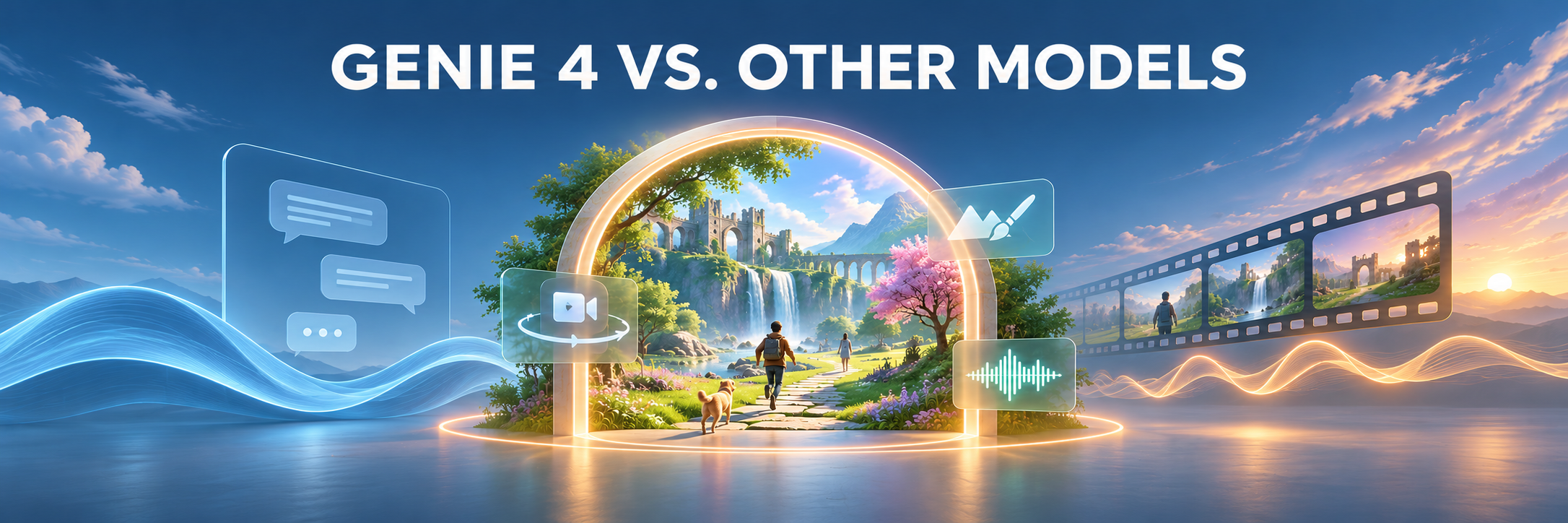
In a Genie 4 vs. other AI models comparison, the defining difference is output type. Google DeepMind announced Genie 4 on October 27, 2026 as a world model for real-time interaction. Users can navigate and alter scenes by prompt, with ambient sound, music, and dialogue generated alongside them.
Genie 4 is an interactive world model in Google DeepMind’s Genie line. It combines world generation with Gemini capabilities. In Google’s official announcement, Gemini Omni helps anchor the simulation in realistic appearance and behavior, while other Gemini models provide reasoning, coherence, and continuity.
One naming distinction matters: Genie 4 is not officially described as “Genie 4 built on Gemini Omni Flash.” Gemini Omni is one part of the Gemini family supplying capabilities. Gemini 3.8 Flash separately acts as a guiding agent by observing the scene, breaking goals into steps, and adapting the plan. So the clearest description is that Genie 4 combines Gemini-family capabilities, with Omni anchoring the visual world and other Gemini models supporting reasoning.
What Genie 4 Actually Generates
A conventional model usually returns an artifact: text, code, an image, or a video file. Genie 4 returns a running environment. The output can continue to change as the user moves the camera, introduces an object, changes the weather, or starts a new event.
The Google DeepMind launch article reports four defining capabilities:
It supports live natural-language edits, models physical and character behavior, generates ambient audio and dialogue with the scene, and uses Gemini models to follow multi-step goals and preserve continuity.
This changes the unit of work: an LLM prompt produces a response, a video prompt produces a clip, and a world-model prompt starts or redirects an experience. That difference matters more than a comparison of parameter counts, which Google has not published for Genie 4.
Model type | Main output | Interaction | Typical job |
|---|---|---|---|
Conventional LLM | Text, code, classifications, plans | Prompting, conversation, tools | Writing, analysis, research, software work |
AI video generator | A finished video clip | Prompt and reference-image conditioning | Ads, short films, social video |
Interactive world model | A continuously running simulated environment | Navigation, live edits, events, conversational interaction | Games, agents, robotics training, experimental design |
Genie 4 vs. Conventional LLMs
The main difference is the output medium. Google’s Gemini API documentation presents text generation as producing written responses from text and other inputs. LLMs are strong at summarizing evidence, explaining concepts, and calling tools; their work is usually inspected as language.
Genie 4 is inspected by entering the scene. It must preserve geometry and object identity while reacting to controls in real time, a harder continuity problem than answering isolated text turns.
The types are complementary. An LLM can write a scenario or evaluate the result; Genie 4 can turn part of that scenario into an explorable environment. Google says language and code models can plan structure while Genie renders physical reality.
Genie 4 vs. AI Video Generators
Video generators such as Veo also create moving images, but they are designed around a generated clip. Veo’s official model page describes cinematic video with audio and generation from text, images, or audio.
The practical distinction is control over time. A video model usually commits to a sequence. Genie 4 can change that sequence while the world remains active. Users can explore unspecified camera directions, add events, or alter the environment.
A video generator is better for a polished, fixed clip. Genie 4 suits experimentation and navigation. Longer sessions can drift, so it is a weak substitute for a carefully controlled final render.
Genie 4 vs. Other World Models
Other AI models can also predict future frames or generate 3D-looking scenes. The useful distinction is how much of the world state stays coherent while a user acts. Walking forward should change perspective, objects should remain in place, and a new action should alter the scene without resetting it.
Genie 4’s advance combines real-time realism, live steering, and native multimodal output. Sound is not added in a separate editing pass; Google says the environment and its audio are generated together. Characters can speak and react during the simulation.
This makes Genie 4 relevant to interactive entertainment and synthetic training. A game team can prototype spatial ideas, a robotics team can test a scenario before moving to hardware, and a creative team can explore variations inside one session. These are potential uses, not claims of dedicated production readiness.
Where Genie 4 Still Falls Short
Genie 4 is still an experimental research model. Google’s own limitations section says visual details and object permanence can shift over time, especially after long sessions, several complex edits, or extensive navigation. Complex physical interactions, legible text rendering, spatial accuracy, and real-time audio accuracy remain active research areas.
Those limitations should shape the workflow. A creator can use Genie 4 for ideation, then use a conventional video pipeline for a controlled final asset. A developer can use an LLM for planning and evaluation while treating Genie 4 as the simulated environment beneath the agent.
Google has not published a standalone per-run price for Genie 4. Google’s November 18 update says Project Genie is rolling out to eligible Google AI Ultra subscribers, with Google AI Pro members able to join a waitlist. Readers should confirm access in their account rather than infer a price from another Gemini product.
Which Model Should You Use?
Choose a conventional LLM when the task is to reason, write, classify, plan, or operate software. Choose a video generator when the deliverable is a polished clip. Choose an interactive world model when the value comes from exploration, changing events in real time, or testing how a system reacts inside a scene.
The difference between Genie 4 and other models is therefore structural. Genie 4 is not a larger chatbot and not simply an AI video maker. It is a model for experiences that remain alive while a person or agent interacts with them.