


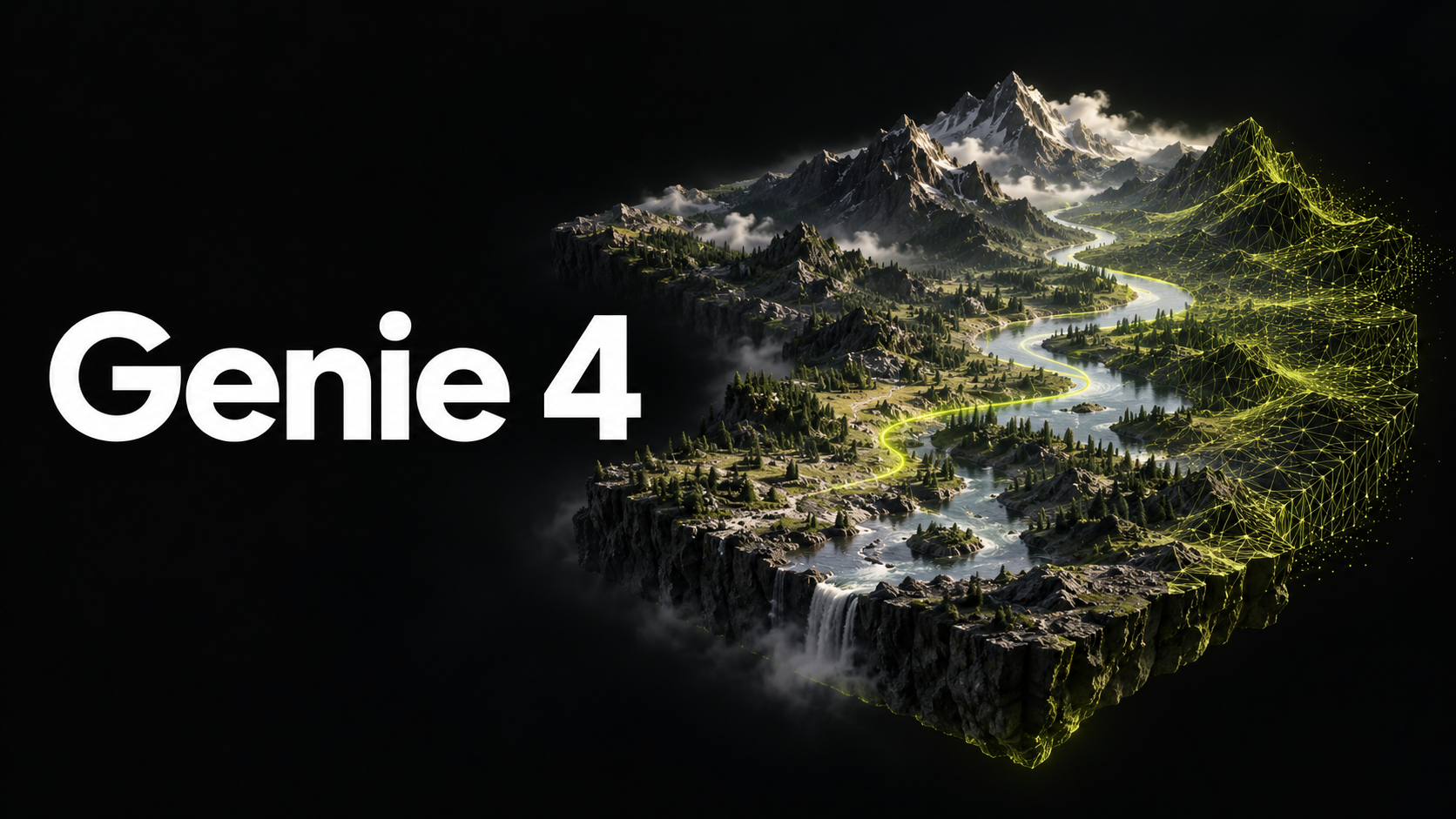
Google DeepMind announced Genie 4 on October 27, 2026, bringing native audio and live scene editing to its world-model research. Google's demonstrations show users changing the weather, moving the camera, and introducing characters while a scene unfolds. The environment also generates ambient sound, music, and dialogue as it runs. The model is currently a research preview.
The interesting shift is what happens after the first image appears. A viewer can intervene, and the model has to continue from that intervention. That creates a different challenge from producing an attractive clip: every new action puts the scene's continuity to the test.
What a world model actually does
A world model predicts how an environment develops and how actions affect it. In a navigable generated world, turning a corner requires the system to produce a new view that fits the surroundings. Moving forward changes what it needs to show next.
Google's earlier Project Genie introduction explains this distinction through a prototype that generates the path ahead as the user moves. That app originally combined Genie 3, Nano Banana Pro, and Gemini. It supported creating worlds from text and generated or uploaded images, then exploring and remixing them.
The distinction between the model and the app matters. Genie is the world-model family; Project Genie is an interface for experiencing that research. Having access to Project Genie does not necessarily mean you have access to Genie 4.
For someone familiar with video generation, imagine a camera move whose direction you choose while watching. You might approach a doorway, pause, and look back. The value lies in being able to make those decisions during the experience. A finished video records one route through a scene; an interactive model must respond to the route you take.
How Genie 4 uses Gemini to guide a scene
In its launch post, DeepMind describes Gemini 3.8 Flash as a guiding agent. It observes incoming frames, breaks goals into steps, checks progress, and adjusts its plan when the user intervenes. Gemini Omni helps the simulations reflect how the real world looks and behaves.
This arrangement gives Gemini a role in keeping events on track while Genie generates the scene. A scene can look plausible while losing the thread of what was supposed to happen.
DeepMind's demonstrations also use reference images to establish a scene. These provide a visual starting point for exploration; they do not establish that everything beyond the image has been faithfully reconstructed.
The same launch report describes trusted testers exploring filmmaking, interactive prototypes, and simulation. For creative teams, this suggests a practical starting point: trying out a scene before committing to production.
Why native audio matters
Native audio gives an interactive environment another way to respond. A change in the scene can have an audible consequence, and generated characters can participate in dialogue as events unfold. Google's announcement identifies ambient sound, music, and interactive speech as parts of Genie 4's output.
Consider an imagined creative exercise: a director explores a station platform and changes the weather during the scene. Evaluating the result would involve more than checking the rain. Do the sounds fit the new setting? Does dialogue remain coherent? Does the location still feel like the same place?
Those questions make sound part of evaluating the simulation. A visually convincing response can still feel disconnected if the audio fails to follow the action.
Where realism still breaks down
DeepMind's Genie 4 model page lists several important limitations. The model can support a few minutes of continuous interaction. Visual details and object permanence can drift, particularly during longer sessions, extensive navigation, or repeated complex edits. Real-world locations are not reproduced perfectly, and interactions among multiple agents remain a research challenge. Audio accuracy and legible text also need improvement.
Object permanence means that an object continues to exist even when it is out of view. In a generated scene, an object should not disappear or become something else simply because the camera turns away. For a viewer, a small change in a background object may be tolerable. For a task that depends on returning to a particular object, that same change could undermine the exercise.
This is why photorealism alone is a poor measure of readiness. For a proposed training application, the useful question is whether the relevant relationships survive the actions being tested. A persuasive image cannot establish that a simulated outcome predicts a physical one.
DeepMind says generated video and audio will carry SynthID watermarking. The watermark is designed to help identify AI-generated content; it does not verify whether a scene is factually accurate.
Describe an experience you can evaluate
Google's earlier Project Genie prompting guidance recommends specifying the environment, the character and its movement, and using direct language. For image prompts, it recommends including enough background to establish the setting. These are useful starting principles, although that guide predates Genie 4.
For example, you might describe a quiet stone courtyard in light rain, seen from the perspective of someone walking slowly toward an open archway. This gives the scene a setting, a direction of movement, and a clear atmosphere without piling on competing instructions.
For evaluation, change one thing at a time. Check the initial scene, move through it, then request a weather change. This makes it easier to notice whether an edit disrupts the layout or whether an error was already present.
Who can use Genie 4?
As of October 28, 2026, Google describes Genie 4 as a research preview rolling out to trusted testers. Google says access is coming soon to Google AI Ultra subscribers through Project Genie and to early-access partners through the Gemini API and Google AI Studio. The announcement does not provide a general release date or public API pricing.
For now, Genie 4 offers an experimental way to explore a generated scene and change it as it unfolds. Its promise depends on how well a world holds together after the user starts making decisions. That is the capability worth watching as access expands.