


Consider a customer message: “I was charged twice for my subscription. Please reverse the extra charge.” A support system needs to identify the issue, check the payment records, and explain the outcome to the customer. Each step asks something different of the software.
Jev, a model from TypeSafe AI, is designed for the judgment calls in that process, such as choosing which team should handle the request. A general-purpose large language model can make those judgments too, while also writing replies, summaries, and code. Choosing between them starts with what you need the model to return.
What Jev returns from the same input
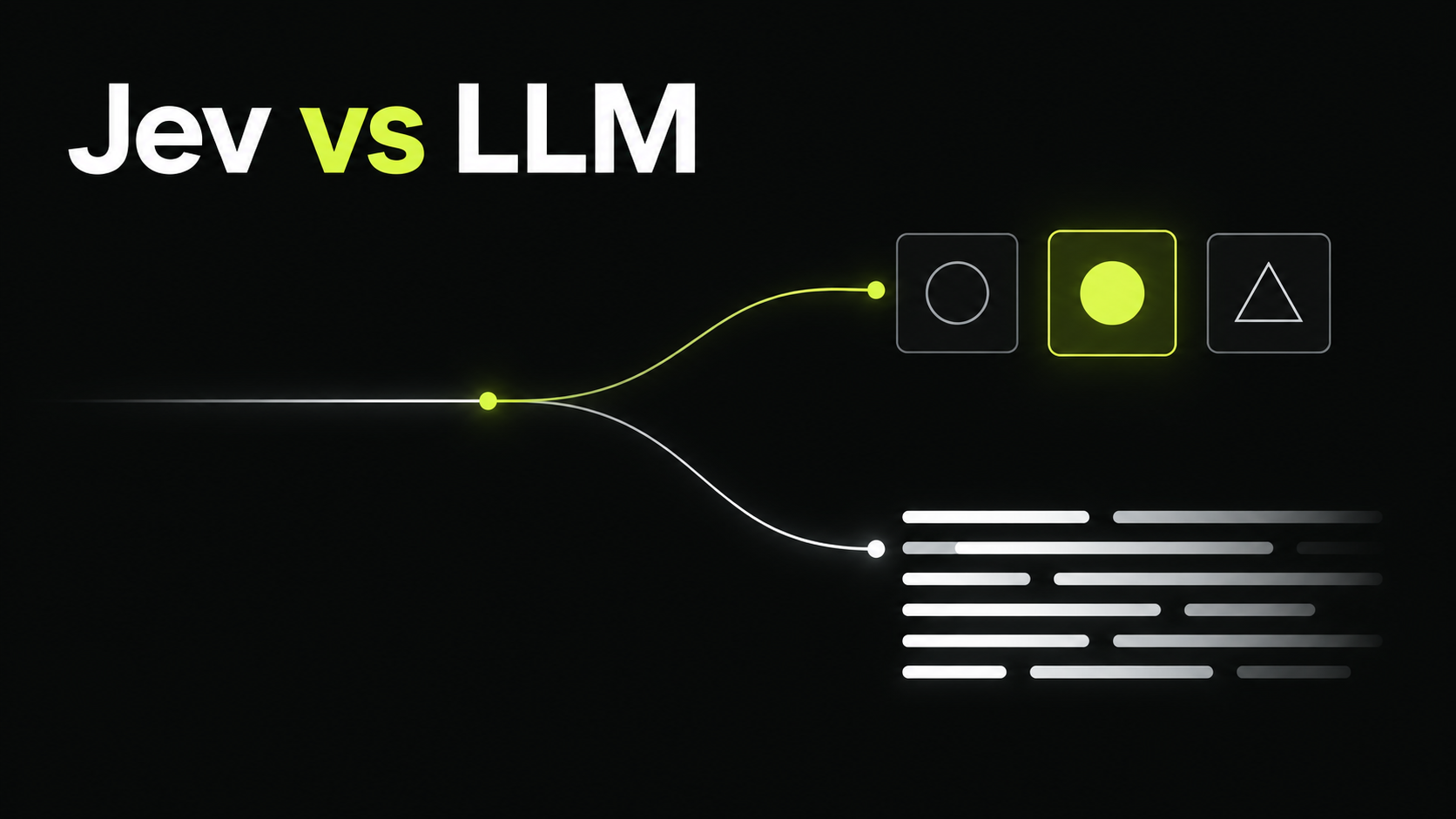
Jev reads the information you supply and answers questions in three formats. Choice selects from a list of options. Score rates the input against a scale you define, such as levels of urgency. Noul returns a probability between zero and one for a yes-or-no question.
For the subscription message, you could ask Jev to choose from billing, technical support, and account access. The expected department would be billing, accompanied by probabilities across the available options. A separate question could assess whether the customer requests a refund. Neither judgment establishes that two settled charges exist; checking that requires the transaction records.
A language model could perform the same classification and then draft a response. Jev cannot write that response. With Jev, the application supplies the available choices and scoring criteria in advance.
Dimension | Jev | General-purpose generative LLM |
Output | Predefined choices, scores, or probabilities | Generated text, including structured fields |
Open-ended writing | Not supported | Replies, summaries, explanations, and code |
Several judgments | Independent questions evaluated in parallel | Often a generated sequence; implementation varies |
Uncertainty | Native probabilities; separate confidence for Choice and Score | Depends on the model and inference method |
Extracting a name from text | Needs candidate values to choose from | Can return a name found in the input |
Jev evaluates its questions independently against the same supplied information, called the state. If a later question needs an earlier answer, the application must arrange that sequence. Sending both together does not make one depend on the other.
What “System One” means
TypeSafe calls Jev a System One model. The name borrows from Daniel Kahneman’s distinction between fast, intuitive System 1 thinking and slower, deliberate System 2 thinking. TypeSafe uses the analogy to describe the focused judgments Jev is designed to make. It is the company’s name for this approach, not a claim that Jev thinks like a person.
A focused question might ask whether the customer explicitly requests a refund. Resolving the whole dispute requires more: transaction checks, policy interpretation, and possibly additional evidence. Those steps need to be separated rather than hidden inside one broad question.
TypeSafe says its training method, Reinforcement Learning for Calibrated Decisions (RLCD), optimizes decisions and their probabilities. In a well-calibrated system, outcomes assigned an 80% probability should occur about 80% of the time across comparable predictions. That makes uncertainty useful when deciding which cases need further review.
Probability and confidence also need careful reading. For Choice and Score, Jev returns a separate confidence value describing how concentrated the probabilities are; Noul has no separate confidence field. A confidence value of 0.8 therefore does not automatically mean 80% correctness. TypeSafe’s confidence guide recommends testing thresholds on the actual task.
LLMs already support structured output
Comparing Jev with an unconstrained chatbot misses the closest alternative. Modern LLM APIs can constrain responses to a schema that specifies the allowed fields and values. OpenAI’s Structured Outputs, for example, can restrict a department field to your approved categories. Applications must still handle refusals or incomplete responses, but classification does not require parsing a conversational answer.
Jev is built around choosing or scoring answers within limits you set, with probabilities included in the result. It can evaluate several independent questions in parallel. An LLM offers more flexibility within a structured response: it can return a department label alongside a newly written explanation. That can be useful when the next step needs both.
A correctly formatted answer can still be wrong. In the subscription example, “technical support” could be an allowed output and still send the customer to the wrong queue. TypeSafe’s “no hallucinations” claim means Jev cannot return an answer outside its permitted output types. It can still choose the wrong answer from the list.
The provider’s Jev 1.13 limitations include unreliable arithmetic and date comparisons, difficulty with indirect questions, and susceptibility to adversarial content. A model identifying a refund request should not also be trusted to calculate the amount owed.
How to read the speed and cost claims
Jev avoids generating a textual answer token by token. TypeSafe reports response times of 70–500 milliseconds for suitable queries. Its model documentation lists Jev 1.13 at $0.042 per million input tokens, with no output-token charge.
The setup matters when reading TypeSafe’s launch evaluations. They use averaged predictions from GPT-6 Astra and Claude Fable 5.1 as reference answers, so agreement with those models is not the same as independently verified correctness. The LLM comparison also requests probabilities, which the company says increases time and cost. TypeSafe acknowledges that its headline gains are likely toward the high end of real-world results.
A useful comparison would give a small, capable LLM the same cases and require only the output the application needs. Include wrong decisions, fallback calls, and review effort in the cost calculation. A cheaper classification that sends more customers to the wrong queue can create work elsewhere.
Choosing the model for each step
For the support workflow, code should retrieve the transaction records and check amounts and dates. Jev could classify the message and assess escalation criteria. An LLM could draft the reply from the verified records, while ambiguous cases go to a person. This division keeps each judgment close to the evidence it needs.
Jev is worth testing when your application spends a lot of time or money on repeated classification tasks. If those tasks are occasional, or you need a written explanation with every answer, using the LLM you already have may be simpler. Adding another service takes work even when each call costs very little.
Start with one recurring decision and compare results on representative examples, including unclear requests. For the subscription customer, success means getting the charge checked, the problem resolved, and a clear explanation of what happened. Jev is useful if it helps your application reach that outcome faster or at lower cost while maintaining the accuracy you need.