


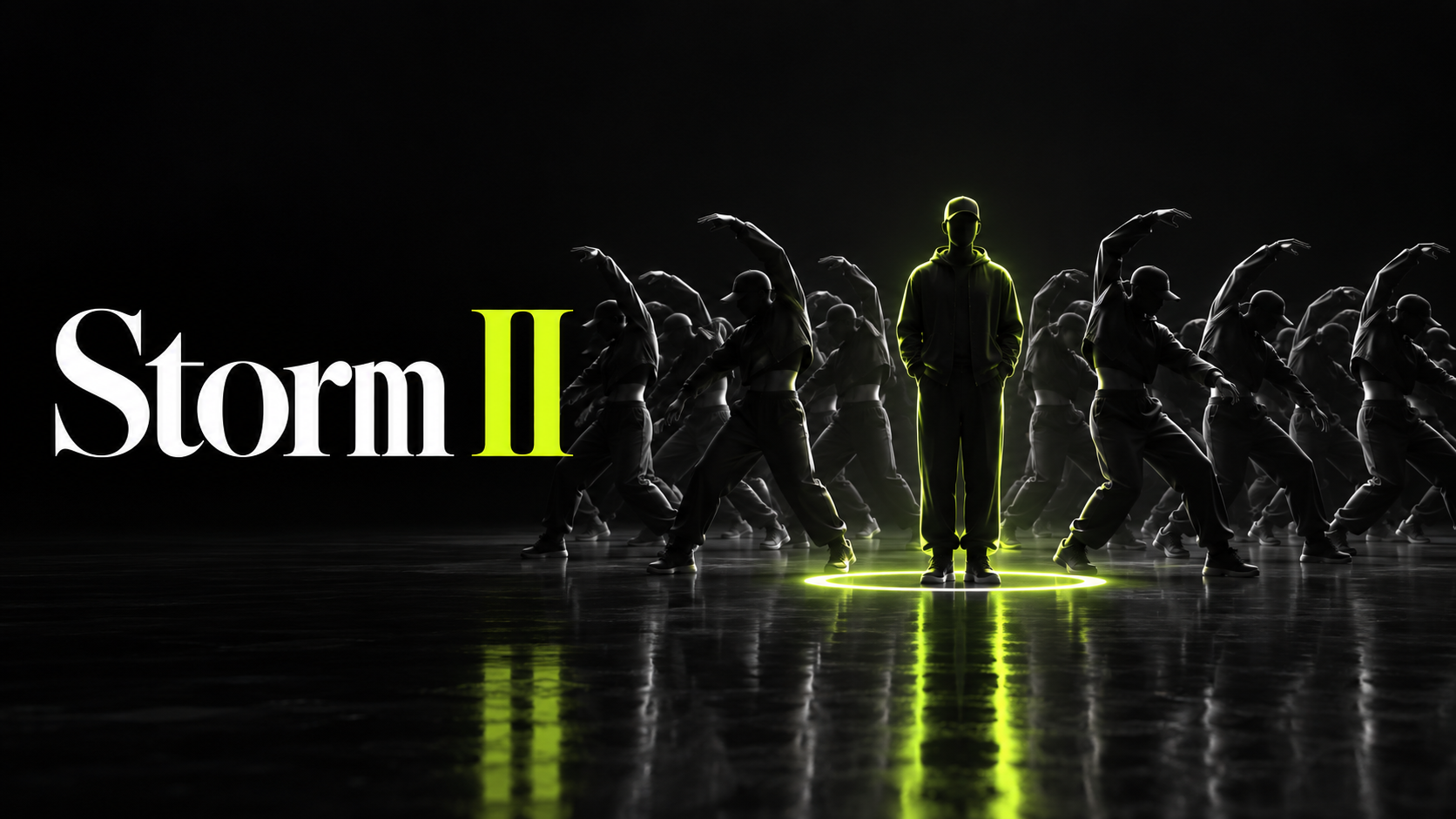
A man holds the center of the frame while the crowd around him moves in tightly coordinated waves. That contrast gives the Storm II sequence its pull: one figure is easy to follow, yet there is always something happening elsewhere in the image. Change the central character and the scene becomes familiar and strange at once.
That is the appeal behind the AI remixes now circulating around Storm II. Creators are using a recognizable performance as the basis for a new cast or appearance. For anyone making short-form video, the interesting question is how much of that performance can survive the transformation—and which creative decisions make the result worth watching.
The choreography comes first
Storm II belongs to GENER8ION and Yung Lean's larger STORM film, which brings together Storm I and Storm II. The film's credits name Romain Gavras as director, Damien Jalet as choreographer, and Ben Surkin as creative director. Their staging gives the remixes something specific to work with: a central performer framed by coordinated group movement.
ABC's coverage of STORM describes a school setting and two distinct chapters joined by Yung Lean's presence. The group choreography gives the later sequence a visual structure that remains legible even in a short excerpt. The crowd fills the image, while the central figure provides somewhere for the eye to settle.
That arrangement leaves room for a remix to change one conspicuous element. A new face, costume, or character can become the joke or the surprise without requiring viewers to learn a new scene. The reference still supplies the surrounding action. This is a useful creative constraint: a recognizable setup makes a small alteration more noticeable.
An X prompt shows what creators want to preserve
One particularly useful example is Al-Shamus's Storm remix on X. Posted on September 14, it places a character in a bright lime blazer at the center of a dark-clothed crowd. The author labels it as made with Seedance 2.5 and shares the accompanying prompt in replies.
The published prompt assigns movement and camera behavior to the reference clip, appearance to the uploaded photograph, and wardrobe to written instructions. It requests replacement of the central man while leaving the other performers unchanged. The continuation reduces the approach to one line:
“Reference video controls motion; @image1 controls the replacement actor's identity.”
The lime jacket makes this example worth studying. Its color separates the replacement character from the surrounding performers as the composition widens. Even when bodies overlap, that bright patch gives the viewer a way back to the lead.
The prompt's demands are also revealing. It asks for consistent identity, unchanged choreography, and matching camera rhythm. Those are instructions, rather than proof of flawless execution. A shared result cannot tell us how many attempts were discarded or whether additional editing happened. What the thread does provide is a clear explanation of the creator's priorities, alongside a clip readers can inspect for themselves.
Reference video becomes part of the brief
A reference clip carries instructions that would be cumbersome to write out: how far a performer turns, when the group moves, and how the camera follows. Once those decisions are visible in the footage, the text can focus on the proposed changes. Asking for a different camera move at the same time would change the brief again, so it helps to settle the performance before experimenting with a new viewpoint.
The scope of the edit deserves equal attention. Replacing the lead leaves the surrounding performance as a visual anchor. Redesigning the ensemble means judging every replacement as well as how the figures overlap and move together. Before choosing a workflow, decide whether the idea really needs a new crowd or whether one carefully chosen replacement carries it.
For creators, the useful habit is to decide what must remain recognizable before generating. In a dance clip, it might be a coordinated turn. In a character introduction, it could be the moment the camera reveals the surrounding group. If that moment disappears, extra visual detail will do little to rescue the idea.
This also suggests a more personal way to participate in a trend. Keep the compositional idea that interests you, then develop your own setting and performance. A calm mascot surrounded by energetic dancers, for instance, could borrow the central visual contrast without depending on the original school scene.
Try the idea at a manageable scale
SeeAPI's Seedance workspace presents image and video references as ways to guide motion and appearance. For a focused experiment, its Motion Transfer AI workflow describes uploading one or two character images alongside a reference video, with optional instructions for the setting, visual style, camera, or effects.
That makes a short solo or paired performance a sensible starting point. Choose a clip in which the subjects are easy to distinguish and their movement is visible. Add a clear image for each intended character. If the reference already communicates the action, use the text field for the specific change you want to explore.
For an original solo dance reference, you could try:
Use the portrait for the dancer's appearance. Follow the movement and tempo of the uploaded rehearsal clip. Place the performance on a dark studio stage, with a yellow-green jacket and subdued lighting. Keep the dancer's face and clothing consistent throughout.
Keep the first experiment within the one- or two-character setup the tool describes. A full crowd replacement needs its own evaluation; success with a solo performer will not establish how well the larger scene holds together.
Review the moments when a character turns away or disappears behind another person. Does the same face return? Does the jacket keep its shape and color? Then watch at normal speed to judge whether the gesture lands on the intended beat. A result can look convincing in a still frame and lose the performance in motion. If a particular overlap breaks the shot, try a shorter excerpt with a clearer view of the subject before changing the entire prompt.
The appeal of a Storm II remix depends on the viewer recognizing the performance through the change of character. Its most useful lesson for creators is to choose that change deliberately: keep the movement that gives the scene its identity, give the audience a clear subject to follow, and check that both survive beyond the best-looking frame.